Friday, July 1, 2011

K2 Mountain

History of K-2 Mountain


K2 is the second-highest mountain on Earth after Mount Everest. With a peak elevation of 8,611 metres (28,251 ft), K2 is part of the Karakoram range, not far from the Himalayas, and is located on the border between the Pakistani-controlled territory of Gilgit-Baltistan, in the disputed Kashmir region, and the People's Republic of China's Taxkorgan Tajik Autonomous County of Xinjiang Autonomous Region. It is regarded by mountaineers as far more challenging to summit than Everest, and is generally looked upon as one of the most dangerous mountains in the world.
The climbing season at K2 lasts from June to August, but in 2008 adverse weather prevented any groups from summiting during June and July. At the end of July, ten different groups were awaiting the possibility to reach the summit, some of them having waited for almost two months. The months preceding the summit push were used for acclimatization and preparing for the camps higher on the mountain, the highest of them, Camp IV, just a little short of 8000 m above sea level.

Sunday, June 26, 2011

Pakistan Monument


Pakistan Monument

The National Monument in Islamabad, Pakistan is a national monument representing the four provinces and three territories of Pakistan.

The Monument has been designed to reflect the culture and civilization of the country and also depicts the story of the Pakistan Movement, dedicated to those who sacrificed themselves for future generations. The reddish granite marbel is used in the construction,which is very expensive but the most strong and beautiful stone


.

Monday, June 13, 2011

Old Anarkali Bazaar


The market derives its name from a nearby mausoleum thought to be that of a slave girl named Anārkalī, buried alive by order of the Mughal Emperor Akbar for having an illicit relationship with the Emperor's son, Prince Salīm, later to become Emperor Jahāngīr.
Anarkali Bazar is the oldest bazaar of Lahore, Pakistan, yet it has coped with the changing times by introducing new trends in business. Today it can be considered as one of the best business centres of Pakistan. Anarkali Bazar is divided into two portions, the Old Anarkali Bazar and the New Anarkali Bazar. The Old Anarkali Bazar is famous for traditional food items while the New Anarakli Bazar is famous for its traditional handicraft and embroidery cloths. Babar Handicraft and Gift Centre is the oldest shop located at 110 New Anarkali. It is famous for its quality of hand made products.
The mausoleum of Sultan Qutb-ud-din Aybak of Mamluk Sultanate is also located at Anarkali Bazaar. In the early 1970s, mausoleum was renovated at the orders of the then Prime Minister Zulfiqar Ali Bhutto.

After occupation of Lahore by East India Company in 1849,the place where Anarkali Bazar is located was selected for a cantonment for the Army.Many barracks are still be seen there.Obviously a shopping area was also needed for army.That was the beginning of this bazar.After sometime cantonment was shifted to new location i.e. Mian Mir but anar kali bazar still ther


Monday, June 6, 2011

Hindu Temple In Taxila

History of Hindu Temple In Taxila


Ram Rakhi in the loving memory of her husband Bahagat Lal Rawalpindiwale constructed this temple in 1932. Before partition there was a considerable Hindu population in Jehlum, which have all vanished - either converted to Islam or migrated to India. The vanishing hindu population left behind these magnificent places of worship, which have now been encroached by muslim migrants from India and Kashmir and are in miserable condition.

Thursday, June 2, 2011

Minar-e-Masoomi

History of Minar-e-Masoomi


The architecture of this tower is probably ungainly but there are few details that make it unique in Pakistan. The number 84 is significant with the architecture here as the tower is 84 ft (26 meters) high. One source claims the height of the minar as 31 meter. The number of steps to reach the top of the tower is 84. The circumference of the base of tower is also 84 feet.
The tower’s historical significance arises from the fact that it was built in 1605-1610 AD. In one of the references I read, the year of completion for the tower is given as 1607 A.D. Even with going with the conservative estimate of 1610 AD means the next year Tower of Masoom will complete 400 years of it existence.
It was built by Masoom Shah of Bukkur (an island on River Indus between Sukkur and Rohri). Masoom Shah was the Governer of the area in times of Mughal Emperor Akbar. The tower was built with the purpose of keeping a watch on the area.

On top of the tower is an observation balcony which is now covered with iron railing. At one time it became nototrious for suicidal people flinging themselves to death below. If you look carefully at the top of the tower in our title photo, you can see this iron railing on the viewing balcony. When was this iron cage built? I couldn’t research the date for sure but the last photo of this post below (circa 1896) shows this cage present, which means the iron cage was present atleast in the British era.


Monday, May 30, 2011

Makli Hill


History of Makli Hill.


The province of Sind has a significant place in history being the gateway of Islam; Bab al-Islam. The great religion entered into South Asia from the Arabian Sea when Bin Qasim defeated Dahir; the Raja of Dibal in 712 AD.
Sind embraced Islam in a way that it touched the boundaries of Multan in days to come, but suddenly, Qasim was called back to home for never coming again to this part of the world. Many of his companions liked the fertile land of Sind up to the extent of making it as their abode for good. Among those who stayed here, were many religious and pious individuals; known as saints or Sufis, they preached the doctrine of Islam to the locals.
The saints and Sufis did not leave this place unless they embraced death which marked the introduction of Islamic burial system in South Asia where owing to Hindu, Jain or Buddhist influences, burning of corpses was in vogue, since ever. 

Thatta or Thatto is a historic town with a population of 22000, considered a momentous place in world heritage. Once it was the capital of lower Sind, from 14th to 16th century. It was under the control of the Mughals until the Persian invader Nadir Shah smashed this area which fell in negligence afterwards.
Thatta is known basically for its historical remains; the Shahjehan Mosque (1647-49), tombs of Jam Nizam al-Din (1461-1509) and a vast ancient necropolis with thousand of graves nearby the Hills of Makli.
Makli is believed to be the burial place of more than 125,000 saints or Sufis. This place is also one of the largest necropolises of the world, located in the outskirts of Thatta.
Apart from other legends, the general belief about this place is that the cemetery developed around the shrine of Hamad Jamali, a Sufi of the 14th century AD.
The monuments and the sepultures scattered over the necropolis are the documented proof in solid stone that reveals to us the social, cultural and political history of Sind.
Extrinsically speaking, we can find the imperial mausoleum of two demarked groups, Samma (1352-1520) and Tarkhan (1556-1592). The Samma king Nizam al-Din is also buried here in a square tomb. An impressive structure built of sandstone and decorated in floral and geometrical motifs. On the other hand, the mausoleum of a Tarkhan king, Isa Khan II is a two-storey building in stone with grand cupolas and balconies.
These structures with both Hindu and Islamic influences manifest the motifs and designs which, can be traced back to the later dynasties of Central Asia. The tomb of Jan Beg Tarkhan is an octagonal brick structure with covering in blue and turquoise glazed tiles.
Imperial mausoleums are divided into two major groups, based on the Samma and Tarkhan periods subsequently.
Today, Makli is a United Nations World Heritage Site that is visited by both pilgrims and tourists.
Thatta is also homes the beautiful Keenjher Lake. Visitors from the neighboring metropolis Karachi, usually spend their weekends here in serenity and timelessness, while at the central part of the city of Thatta, is situated the all famous Shahjehan Mosque.
Makli is a silent place, so silent that one can even listen to the unspoken voices and whispers of the sand particles which, fly around and make eyes watery; a tearful homage to the souls who once were not so silent!

Saturday, May 28, 2011

Chagai For Pakistan Atomic Tests

History of Chagai

File:Pakistan Nuclear Test.jpg

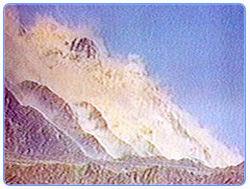
Pakistan's nuclear explosion test in the hills of Chagai Plans to conduct an atomic test started in 1976 when Pakistan Atomic Energy Commission (PAEC) research scientists frequently visiting the area to find a suitable location for an underground nuclear test, 
preferably a granite mountains. After a hectic and day long survey, the PAEC scientists chose the granite mountain Koh Kambaran in the Ras Koh Hills range in the Chagai Division of Baluchistan in 1978. Its highest point rises to a height of 3,009 metres (sources vary). The then-martial law administrator of the province, General Rahimuddin Khan, spearheaded the construction of the potential test sites throughout the 1980s.
Pakistan's nuclear testing in 1998 in Chagai Balochistan
In March of 2005, the former Pakistani prime minister Benazir Bhutto said Pakistan may have had an atomic weapon long before and her father had told her from his prison cell that preparations for a nuclear test had been made in 1977 and he expected to have a atomic test of a nuclear device in August 1977. However, the plan was moved on to December 1977 and later it was delayed indefinitely. In an interview with Geo TV, Dr. Samar Mubarakmand of the Pakistan Atomic Energy Commission, has said that the team of Pakistan Atomic Energy Commission developed the design of atomic bomb in 1978 and had successfully conducted a cold test after developing the first atomic bomb in 1983.


On April 2010, Nawaz Sharif, at a public function to celebrate nuclear blasts, said the then-U.S President Bill Clinton offered a package of US$5 billion for not carrying out nuclear blasts and warned about imposition of ban otherwise. Nawaz said that he was in Kazakhstan in a visit to meet the President, Nursultan Nazarbayev, when India tested its nuclear device. The entire nation was united in favour of nuclear blasts and Mushahid Hussain was the first person who advice that nuclear blasts should be carried out in reply of Indian nuclear explosions. In 1999, in an interview given to Pakistani and Indian journalists in Islamabad, Sharif had said: If India had not exploded the bomb, Pakistan would not have done so. Once New Delhi did so, We [Sharif Government] had no choice because of public pressure.